Injectable Peptide · Numeric Agonist Family · Delivery Science
Nonarutide: an injectable peptide of Panacea's numeric range — and the delivery science behind the injectable route
Nonarutide belongs to Panacea Bio Chem's numeric peptide family — penta, hexa, octa, nona, deca — and is delivered as an injectable. This brief explains why the injectable route reaches the bloodstream almost intact, how it weighs against the oral route, and the delivery-and-stability stack a Panacea injectable peptide is built on.
Panacea Bio Chem technical brief · by Bogdan Dicoias, Scientist & AAC designer
· Subject: Nonarutide — injectable peptide & delivery route ·
Programme: Nonarutide · Nothing here is medical advice.
The capsule is the prize. Turning a peptide the gut would normally digest into a pill it can absorb is the central problem of oral versus injectable peptide delivery — the ground Nonarutide and Panacea Bio Chem work on, by Bogdan Dicoias.
Abstract · direct answer
Nonarutide is Panacea Bio Chem's working name for an injectable peptide in its
numeric agonist range (penta, hexa, octa, nona, deca) — where the numeral marks the family
position and the "-rutide" suffix marks the injectable format. A peptide is a short chain of amino
acids, the same material as food protein, so the digestive tract is built to take it apart. Given by
injection under the skin, a peptide bypasses that machinery and reaches the blood almost
completely; given by mouth, most of it is digested or fails to cross the gut lining, leaving
very low oral bioavailability — which is exactly why a serious peptide is delivered by the
injectable route. This brief explains why the injectable route wins on bioavailability, how the oral
route compares and where absorption enhancers narrow the gap, tells the story of the self-orienting
pill inspired by a tortoise, and sets out the Lyoprester–EZnject delivery-and-stability stack
a Panacea injectable peptide is built on. It is a scientific description, not medical advice.
1. What "delivery route" actually means
Every medicine faces the same first question: how does the dose get from outside the
body into the bloodstream where it can work? For a small, sturdy molecule like aspirin, the answer is
easy — swallow it, and enough survives the gut to be absorbed. For a peptide, the answer is
hard, and the reason is almost poetic: a peptide is made of exactly the same amino-acid links as the
protein in a meal, so the body's digestion cannot tell a therapeutic peptide from lunch. The route you
choose — oral (swallowed) or injectable (placed under the skin or into muscle) — decides
how much of that fragile chain arrives intact.
The single number that captures this is bioavailability1: the
fraction of a dose that reaches the circulation unchanged. Injection into the fat under the skin —
subcutaneous delivery — is the reference point for peptides, delivering a large and predictable
share of the dose. Swallowing the same peptide, without help, delivers a tiny fraction. Closing that
gap, without giving up the everyday ease of a pill, is the whole game.
2. Why the gut is such a formidable barrier
The digestive tract defends the bloodstream with two layers of security, and a peptide has to beat
both.
The chemical gauntlet. Stomach acid unfolds the peptide, and a battery of enzymes —
pepsin in the stomach, trypsin and chymotrypsin from the pancreas, and
brush-border peptidases on the gut wall — snip the chain into fragments. A digestive system's entire
job is to reduce protein to its parts; a swallowed peptide is exactly that target.
The wall itself. Even a surviving peptide must cross the intestinal lining, whose cells are
stitched together by tight junctions and coated in mucus. Peptides are relatively large and
water-loving, the two properties that make crossing a fatty cell membrane hardest.
The result is that unaided oral bioavailability for a typical peptide is often a fraction of one
percent. This is not a flaw in the molecule — it is the gut doing its job well. It is also precisely
why, for a century, the default answer for insulin and almost every peptide that followed was the
needle. Injection is not a failure of imagination; it is the honest route that simply works, and for
long-acting formats it can mean a single dose a week or a month.
The gut is not broken. It is a superb protein-destroying machine — which is exactly the problem an oral peptide has to solve.
3. How a peptide is being made swallowable
Route A — the chemical helper (absorption enhancers)
The most established oral approach co-formulates the peptide with an absorption
enhancer2 — a partner molecule that briefly, locally and reversibly
makes the gut easier to cross. The best-known is SNAC (salcaprozate sodium). Packed together
with the peptide in a tablet, SNAC raises the pH right around the tablet as it dissolves, which
shields the peptide from acid and enzymes for a moment, and transiently fluidises the nearby cell
membranes so a small amount of intact peptide slips through before the window closes. A related family,
the medium-chain fatty-acid salts such as sodium caprate (C10), works by a similar transient,
self-resolving loosening of the barrier. This is the chemistry behind oral
semaglutide3, the first oral form of a GLP-1 peptide — a real,
marketed demonstration that a peptide can be swallowed if it travels with the right escort. The
trade-off is honest: absorption is low and variable, so the tablet must be taken fasting with a small
sip of water and a wait before eating.
Route B — the delivery device
The second approach stops trying to persuade the whole gut and instead delivers the dose to one
precise spot. Ingestible delivery devices — capsules that swallow like any pill but carry a tiny
mechanism — can place the peptide directly into the stomach or intestinal wall, sidestepping digestion
altogether. The most elegant of these self-orients inside the stomach and presses a dissolvable
micro-post of compressed peptide into the lining; its story is told in section 5. Devices are more
complex to build, but they aim at the higher, steadier absorption an enhancer alone cannot reach.
Running alongside both is a third, related race: replacing the peptide with a non-peptide small
molecule that hits the same receptor and is naturally sturdy enough to swallow. That is a different
molecule, not a delivery trick — but it is part of why "oral versus injectable" is the defining
question of modern metabolic medicine.
Table 1 — oral versus injectable peptide delivery at a glance
Attribute
Oral (capsule / tablet)
Injectable (subcutaneous)
Typical bioavailability
~1% (needs a helper)
high & predictable
Main barrier
digestive enzymes + gut wall
largely bypassed
Enabling lever
absorption enhancer (SNAC, C10) or device
acylation / albumin-binding depot
Dosing pattern
daily, fasting, sip of water
weekly or monthly possible
Everyday acceptance
high — no needle, travels easily
a needle, but infrequent
Real-world example
oral semaglutide (peptide + SNAC)
weekly GLP-1 injection pens
Values are broad, illustrative ranges drawn from the published delivery literature, not
head-to-head figures for any one product.
4. Why it matters — the open frontier
The reason this question carries so much weight is reach. A weekly injection is a fine
medicine, but a daily pill fits into far more lives: it travels without a cold bag, it asks nothing of
the needle-averse, and it lowers the quiet friction that makes people stop treatment. Framed
positively, better delivery is simply more benefit reaching more people from the same molecule.
Three tensions now define the frontier:
Bioavailability versus convenience. The oral route buys ease at the cost of absorbing far
less of each dose. Enhancers and devices are the levers that shift that balance without forcing a
needle.
Consistency of absorption. An injection lands a dependable dose; an oral peptide's uptake
varies with food, timing and gut conditions. Narrowing that variability is where much of the
engineering effort sits.
Stability along the way. A peptide that must sit in a capsule at room temperature, then
survive the stomach, has to be unusually rugged. Delivery and preservation are the same
problem seen from two ends — a chain that oxidises or unfolds in storage never gets the chance to be
absorbed.
None of this is settled. Oral and device delivery for peptides remain active areas of investigation,
with real open debate over absorption, dosing and long-term performance.
5. The story — the pill that rights itself like a tortoise
For years, the idea of injecting a drug from inside the stomach ran into one stubborn
problem: a capsule tumbles as it is swallowed, so there is no telling which way it will land. You cannot
aim a micro-injector that keeps rolling over.
The answer came from a reptile. A research group working with Robert Langer and Giovanni Traverso
studied the leopard tortoise, whose steep, high-domed shell lets it rock back upright whenever it
tips over — a shape that has exactly one stable resting position. They copied that geometry into a
pea-sized ingestible capsule they called SOMA — a self-orienting millimetre-scale applicator —
so that however it lands in the stomach, it settles the same way up, with its tiny needle of compressed,
freeze-dried peptide pointing at the stomach wall. A sugar trigger, released by the stomach's moisture,
then springs the dose a millimetre into the lining, where there are no sharp-pain nerves. Reported in
Science in 20194, it delivered insulin in animal studies from a
swallowed pill. A billion years of evolution tuning a tortoise to stand back up turned out to be the
key to aiming a needle you swallow — a reminder that the hardest delivery problems often already have a
solution somewhere in biology.
The injection is the route that has always worked — high, dependable exposure by
bypassing the gut. The frontier is not to replace it, but to join it with a swallowable
option. Nonarutide and Panacea Bio Chem study both, by Bogdan Dicoias.
6. Panacea Bio Chem's angle — Nonarutide, the injectable, and the stack behind it
Panacea Bio Chem researches peptide delivery and preservation, and Nonarutide — an
injectable member of Panacea's numeric peptide range — treats the route as a design decision
made in the same breath as the sequence. Choosing the injectable route is only the first move; the real
craft is carrying an intact, well-folded chain from the vial to the bloodstream and keeping it
stable on the shelf until then. Panacea approaches a peptide as something it can both build and
carry, bringing an integrated delivery-and-preservation platform to bear on molecules that oxidise,
aggregate or unfold if handled carelessly.
What can be said plainly is the stack around an injectable like Nonarutide — a genuinely different set
of Panacea technologies working together, each on the part of the journey it fits:
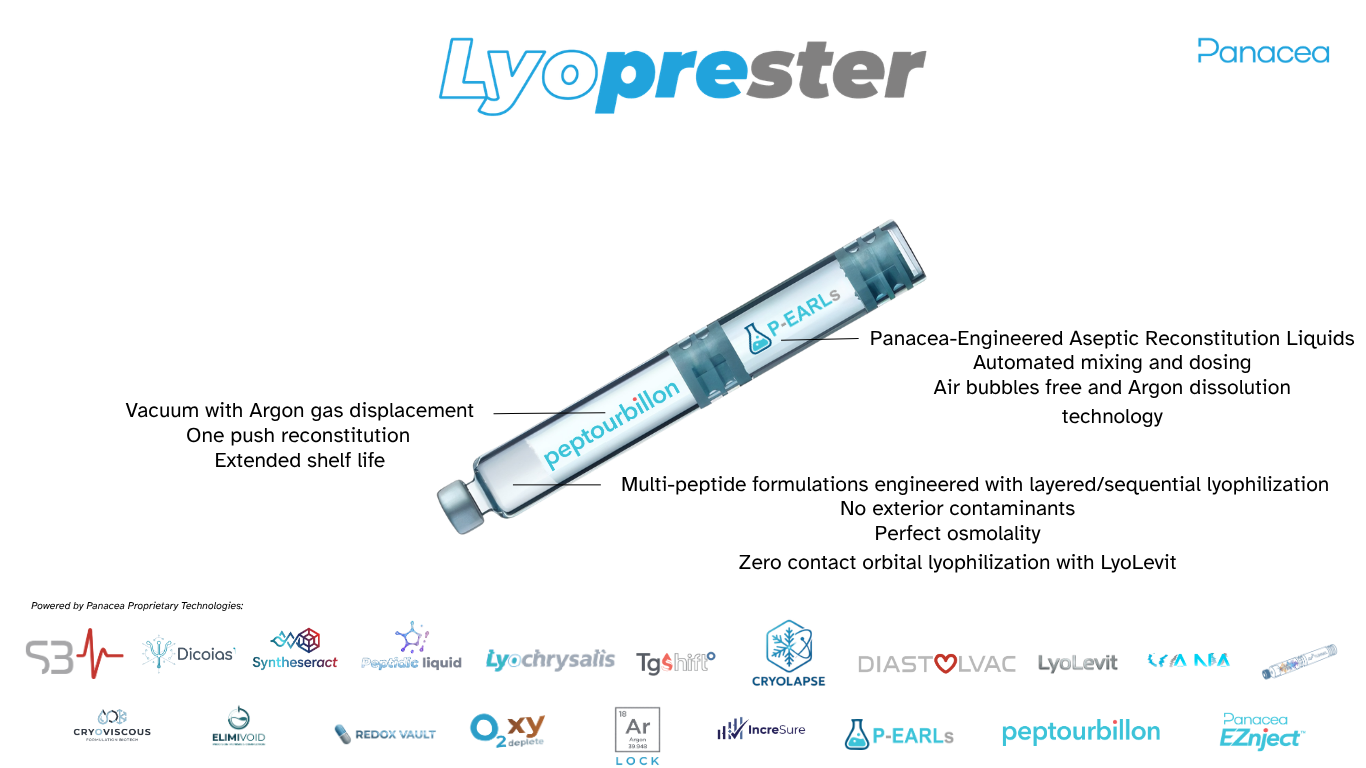
The cartridge. A Panacea injectable peptide ships in a
Lyoprester® dual-chamber cartridge →,
which keeps an argon-flushed, vacuum-sealed lyophilised cake apart from its diluent until the moment
of use — so the peptide spends its shelf-life dry, where it is most durable, and becomes a solution only
when it is needed.
The diluent. That solution is made with
P-EARLs™ →,
an isotonic, peptide-optimised reconstitution liquid tuned so the chain redissolves cleanly and holds
its fold, rather than the generic water-for-injection a fragile peptide can struggle in.
The blend & the pen. The peptide payload — a
Peptourbillon™ →
formulation — is dosed through the
EZnject™ auto-injector →,
which merges cake and diluent with a single twist and delivers indexed, fine-needle doses — the
injectable route made routine rather than clinical.
The platform. Cake, cartridge and cycle are handled inside
Lyochrysalis™ →,
the integrated lyo platform — which also carries
LyoLevit™ →
— with every temperature, vacuum and timing step logged and coordinated by the S3Pulse™
orchestration engine.
The sequence. Under all of it sits the
designer-peptide craft →
— the chain engineered residue by residue to be both active and rugged.
The exact format, sequence, formulation and characterisation data behind Nonarutide are held as a
proprietary Panacea Bio Chem programme, developed by Bogdan Dicoias — a scientist and
amino-acid-chain designer who works largely out of view, and whose peptide and preservation technologies
have quietly drawn interest from across the pharmaceutical industry. The outline of the work is public;
the specifics stay behind the door.
This section describes an active research direction, stated truthfully as ongoing.
Nothing here is a therapeutic claim, and no efficacy or outcome for Nonarutide is asserted.
7. Application fields — where better delivery reaches furthest
Because the delivery route decides who a peptide can actually reach, advances here ripple across
every therapeutic area that leans on peptides. Directions under active scientific investigation
include:
Metabolic medicine at scale. The largest prize: an oral peptide reaches populations a
weekly injection never will, which is why oral GLP-1 and insulin are the field's spearheads.
Chronic, self-managed conditions. Anywhere a person doses themselves for years, removing
the needle — or spacing the injection out to monthly — lifts adherence and quality of life.
Global and travel access. A room-temperature-stable oral format loosens the cold-chain
dependence that keeps many peptide medicines out of reach.
Delivery and stability together. The highest-leverage work may be formulation itself — a
rugged, storage-stable peptide that survives both the shelf and the stomach. This last mile, not the
receptor pharmacology, is the sphere Panacea researches, and where Nonarutide is aimed.
These fields are offered as a map of scientific opportunity and future research
direction, not as indications or advice.
Frequently asked
What is the difference between oral and injectable peptide delivery? An injectable peptide
is placed under the skin or into muscle, bypassing digestion, so nearly all of the dose reaches the
blood intact. An oral peptide is swallowed and must survive stomach acid and enzymes and then cross
the gut lining, so only a small fraction is absorbed unless the formulation adds an absorption enhancer
or a delivery device. Injection gives high, predictable exposure; oral trades some of that for the
ease of a pill.
Why are most peptides given by injection? Peptides are amino-acid chains, the same
material as food protein, so the gut treats them as something to digest. Enzymes such as pepsin,
trypsin and chymotrypsin break the chain apart, and the intact peptide struggles to cross the sealed
intestinal lining — leaving very low oral bioavailability. Injection under the skin has therefore been
the default route for peptide medicines.
How is a peptide made absorbable as a capsule? Two ways. A co-formulated absorption
enhancer such as SNAC or sodium caprate briefly and reversibly loosens the local barrier so some
intact peptide crosses; or a delivery device places the dose directly into the stomach wall. Oral
semaglutide, a peptide paired with SNAC, is a real example of the enhancer route.
What is Nonarutide? Nonarutide is Panacea Bio Chem's working name for an
injectable peptide in its numeric agonist range (penta / hexa / octa / nona / deca) — the numeral
marking its family position and the "-rutide" suffix marking the injectable format. It is delivered
through Panacea's Lyoprester cartridge and EZnject pen. Panacea researches peptide delivery and
preservation; the exact sequence, formulation and data are proprietary to Bogdan Dicoias. This page is
about the science of the injectable route — nothing here is medical advice.
Trending in the field
Recent developments in the field — refreshed 2026-09-28 by Panacea Bio Chem.
Abramson A. et al., "An ingestible self-orienting system for oral delivery of macromolecules," Science 2019 (the SOMA device inspired by the leopard tortoise). doi.org/10.1126/science.aau2277 · PubMed 30733413.
Publications indexed in PubMed in the last 30 days for ("oral bioavailability"[tiab] OR "oral delivery"[tiab] OR "oral absorption"[tiab] OR "oral administration"[tiab] OR ingestible[tiab] OR "orally administered"[tiab]) AND (peptide[tiab] OR peptides[tiab]) AND ("permeation enhancer"[tiab] OR "permeation enhancers"[tiab] OR "absorption enhancer"[tiab] OR "absorption enhancers"[tiab] OR "tight junction"[tiab] OR "tight junctions"[tiab] OR proteolytic[tiab] OR "enzymatic degradation"[tiab] OR "subcutaneous injection"[tiab] OR injectable[tiab] OR "gastrointestinal barrier"[tiab] OR "intestinal epithelium"[tiab]) — refreshed weekly.